
We often associate having superpowers with ultra strength, speed, or the ability to control things. But what if one of the most transformative superpowers is about release. The superpower that helps you start letting go that you become emotionally and mentally strong.
Only if it was such an easy thing to do. Letting go isn’t a one-night medicine that will change your life forever instantly. It is a process of healing and untangling that knot you’ve been tangled in for years. Letting go is a practice you return to again and again.
Letting go happens in waves. Some days you feel free, and other days that memory stings. It just means that you’re human.
We’re often conditioned to cling:
- to old identities
- to “shoulds” and expectations
- to fear disguised as loyalty or control
Letting go means rewriting those scripts and that takes inner work and compassion.
One of the misconceptions about letting go is that it’s about suppressing that pain. But it’s about allowing yourself to fully feel, face it, and move through it.
In this article, I want to help you make letting go easier. Deciding to let go can be the most powerful and transformative decision you take in your life journey.
What happens when you start letting go?
You start letting go of mental clutter
Your mind becomes lighter and calmer when you start to let go of those past mistakes, regrets, resentments and outcomes out of your control.
Getting rid of mental clutter means you’re making space for everything that actually matters. You’re cutting off the noise by starting to let go.
You let go of the urge to cling in love
When you start letting go of the need to control outcomes or people, you love more deeply and freely.
It is an act of self-love as you stop needing others to complete you. You honour yourself and you suffocate less in the effort to understand people and their actions.
It allows you to attract the right people in your life.
Related: Everyday Self-Love Rituals to Love Yourself a Little More
You Start Letting go of Resistance to Change
Life flows. Seasons shift. You evolve.
When you start letting go of rigid plans and expectations, you move with life instead of fighting it.
You become more resilient, more adaptable, more at ease in the unknown.
You Start Letting Go of False Versions of Yourself
We hold on to roles, identities, and versions of ourselves that we’ve outgrown.
But when you start letting go of who you thought you had to be, you meet the real you underneath it all and start knowing yourself better.
Related: Questions to help you Know Yourself Better
Letting Go protects Your Energy
You only have so much to give.
Letting go of resentment, perfectionism, or old wounds allows you to reclaim your energy and reinvest it in yourself.
This might also help: Things to do to Protect Your Peace
It Redefines who you are
So much of our emotional space is taken up by things we no longer truly want or need.
When you let go of what drains you, distracts you, or defines you in a way that no longer fits, you create room for the unexpected:
- new dreams
- new values
- new rhythms
- new loves
- a gentler, and a more aligned way of being
How to Start Letting Go with Ease?
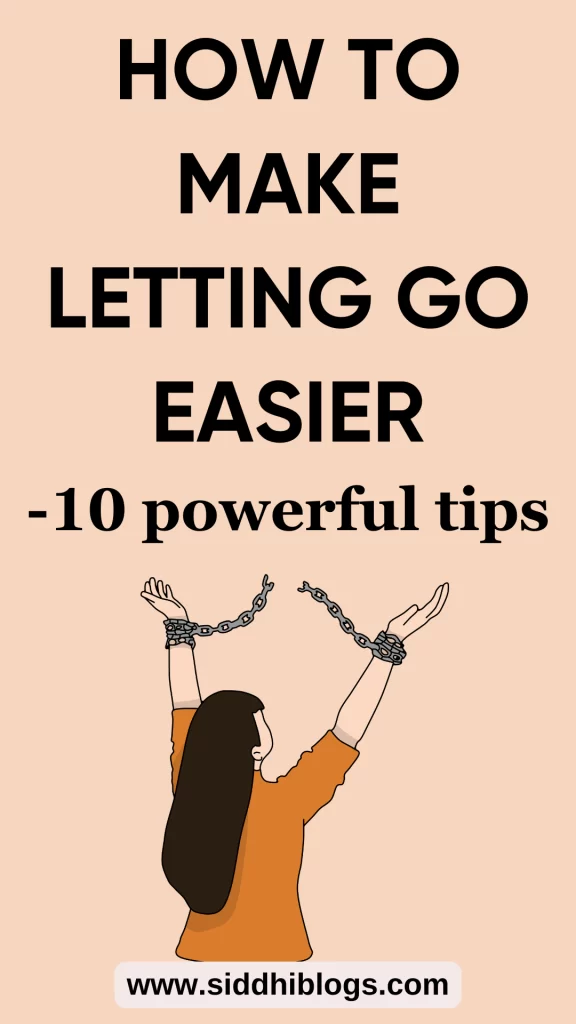
I’m writing this not as someone who has mastered the art of letting go, but as someone right in the middle of it.
I feel like I’m shrinking when I’m tightly holding on to those old patterns, like I’m folding into myself under the weight of things I don’t need to carry anymore.
But when I imagine letting go truly, I see a different version of myself.
I see myself with my head held high, shoulders light, arms open to whatever life wants to give next.
I feel liberated, like there’s more space inside me for peace, for softness, for joy.
Therefore, this article is a reflection of my journey, and maybe yours too. I gently invite you to start letting go with grace, self-trust, and love.
1. Acknowledge What You’re Holding On To
Letting go begins with awareness. Ask yourself:
- What am I still holding on to?
- How is this serving me or not?
- Is it love, fear, guilt, comfort, or habit that’s keeping it alive?
Name it. You don’t have to fix it yet. Just begin by noticing it gently.
You can’t release what you’re not yet willing to see.
2. Validate Your Feelings But Don’t Rush the Process
Letting go doesn’t mean pretending something didn’t hurt. Allow yourself to feel grief, anger, sadness, confusion. All of it is valid.
Letting go becomes easier when we stop pushing emotions away and instead say:
“It’s okay to feel this. And it’s okay to move forward anyway.”
3. Sit with your Past and Future Self
One thing I do when I’m struggling to let go is something quite simple, but incredibly grounding:
I imagine sitting between two versions of myself – my younger self and my older self.
I picture them both clearly:
- The younger me, full of wonder and fear, unsure and innocent.
- The older me, wiser, softer, having already survived this chapter I’m struggling through.
And then, I talk to them.
I ask:
“What would you say to me right now?”
“What do you need me to let go of for your sake?”
“What would make you proud of how I carry this?”
Sometimes, my younger self just wants to be held and told she’s safe.
My older self often reminds me: “This won’t matter as much as you think. Breathe. Keep going.”
Sometimes I cry during this ritual. And it helps. It helps me let go, not all at once, but enough to feel lighter.
It reminds me that I’m not stuck. I’m still growing. I’m still becoming.
Here are questions to ask yourself when you feel stuck.
4. Breathe Space into It
Try a simple breathing exercise to start letting go with ease.
- Inhale: “I acknowledge what’s here.”
- Exhale: “I release what I no longer need.”
With every breath, imagine loosening your grip physically, mentally, emotionally.
Remember that letting go is not one giant leap. It’s hundreds of small exhales.
5. Believe in Impermanence
Buddhist philosophy reminds us that everything is in flux including pain, identities, relationships, and roles. Letting go becomes easier when we trust that life flows, and we are meant to evolve with it.
Nothing is permanent. Neither joy, nor pain, nor success, not even your current self.
When you embrace impermanence, you realise that you don’t have to hold on so tightly.
“This, too, will pass”.
6. Stop Trying to Fit Life into an Imaginary Box
We often complicate our lives and induce stress by holding onto rigid expectations. It’s okay if your life is not what you planned it to be five years or ten years ago.
People won’t always behave the way you hoped.
You won’t always be your ideal version.
And that’s okay.
When you stop forcing things into boxes they were never meant to fit into you invite unnecessary worries.
7. Unhook From the Loop
Our minds replay old conversations, scenarios, regrets and we lose account of our time as we start overthinking.
So, when that happens, I gently bring myself into the present moment:
“I’ve been here before. I choose not to stay here this time.”
You can use grounding tools like meditation, nature walks and snapping fingers as a gesture to bring yourself back, again and again.
This might help: How to Deal with Overthinking
8. Shift Your Inner Dialogue
What you say to yourself shapes how you feel.
Start noticing when you speak from fear, control, or blame and choose a gentler tone.
Try telling yourself:
- “It’s okay to not have all the answers.”
- “I trust that I can handle what comes.”
- “I am allowed to feel, and still move forward.”
Your inner voice can either keep you stuck or help you let go. Let it become your soft landing.
Here’s a positive self-talk guide
9. Replace the Void with Something Nourishing
Children are the most natural examples of letting go. They don’t dwell for long. They cry, then get distracted by clouds, toys, colors, questions.
They’re not replaying yesterday’s argument or obsessing over an ideal version of themselves.
They are immersed in this game, this question, this moment.
That, I believe, is the root of letting go. Being fully where you are, instead of trapped in where you were.
So, when you start letting go, allow yourself to be gentle and intentional about what fills that space created by releasing.
You can choose something gentle:
- A nourishing routine
- A creative outlet
- Time with people who feel like safety
- Silence
Ease comes from replacing old patterns with new peace with intention.
10. Be Happy, No Matter What Others Are Doing
So much of our tension comes from comparison or trying to control how others behave, think, or feel.
Letting go means releasing the need to be understood or validated by everyone.
It means saying:
“I choose peace, even if others choose chaos.”
“I choose joy, even if they don’t approve.”
Happiness is an inside job. And sometimes, letting go is simply choosing not to carry what isn’t yours.
Final Thoughts
Letting go is rarely a simple decision. It’s an emotional, mental, and even spiritual process. The choice to let go feels hard because it often goes against deeply human instincts for connection, control, and certainty.
The act of letting go is an act of courage. It’s how we open the door to new beginnings, more clarity and healing.