As we step into our twenties with hopes and aspirations to be successful in different aspects of our lives, we are confronted with unexpected challenges and setbacks we never predicted earlier. It’s difficult to navigate failure especially the first few ones as they often feel shattering, making us question our self-worth and aspirations.
It is in these moments that resilience becomes an essential inner strength that allows us to recognize failure not as the end of the road but as an important part of life’s journey.
The problem with failure stems not only from our inability to meet a certain goal but also from the social shame and stigma attached to it. And, when we let our decisions be guided by shame and fear, we often feel lost and stuck in our paths.
When we do not meet milestones according to socially accepted timelines, whether it is securing a certain career, earning a specific income, or reaching a personal goal, we often feel not just personal disappointment but also the burden of being “less than” and behind in the eyes of others.
Reframing failure
Yet, failure deserves to be rethought. It is not always a reflection of laziness or lack of talent. More often, it is evidence that we dared to try, and that we cared enough to take a chance.
Take, for instance, the journey of many UPSC aspirants in India. Preparing for one of the toughest examinations in the country often means years of study, multiple attempts, and countless sacrifices. Yet only a small percentage succeed. For those who don’t clear the exam despite their best efforts, the weight of failure and self-worth can become overwhelming.
Many aspirants who could not make it into the civil services later thrive in other fields like academia, entrepreneurship, NGOs, corporate roles, precisely because the skills and resilience they developed in the process serve them elsewhere.
Therefore, at its heart, failure exposes vulnerability. When plans collapse, grades fall short, relationships break, or careers stumble, we are confronted with the limits of our control.
The challenge lies not in avoiding failure, but in how we respond to it. Some people allow failure to define them, internalizing it as proof of their unworthiness. Others deny or minimize it, refusing to confront the lessons embedded in the experience.
A healthier path lies in acknowledgement: to sit with the pain, reflect with honesty, and slowly shift the gaze from “Why me?” to “What now?”
History is full of examples that remind us of this. Thomas Edison famously remarked that he did not fail but rather discovered thousands of ways that did not work before inventing the light bulb.
J.K. Rowling faced numerous rejections before Harry Potter became a household name. These stories are not romanticized tales of overnight success, but testaments to resilience, the ability to walk through failure, gather its lessons, and move forward with renewed clarity.
The Inspiring Japanese Art of Kintsugi
The Japanese art of Kintsugi offers a powerful metaphor for navigating failure. Kintsugi, which means “golden joinery,” is the practice of repairing broken pottery with lacquer mixed with gold, silver, or platinum.
Instead of concealing the cracks, the art highlights them, transforming what was once broken into something unique and beautiful. The philosophy behind Kintsugi teaches us to embrace imperfection, to see damage and breakage not as the end of an object’s value but as part of its history and character.
In the same way, our failures and setbacks need not be hidden or erased. They can become the very lines of gold that shape who we are. Each rejection, each stumble, each “crack” in our life adds to our story, making it richer and more authentic.
Mindset Shifts to Navigate Failure

From Doom and Gloom to Possibilities
Failing at something can often feel like the end of the road, as if no possibilities remain. But that’s rarely the case.
In the age we are living in, opportunities for learning, growth, and reinvention are more accessible than ever. The internet places resources at our fingertips – videos, books, podcasts, blogs, and even AI tools that guide us through challenges and help us reimagine what is possible.
What once seemed like a dead end can often become a detour leading us to new skills and fresh perspectives.
The key is to approach failure with curiosity instead of despair. Rather than thinking, “I’m done,” we can shift to asking, “What else can I try?” or “How can I restart differently?”
Always be ready for a restart. Failure does not erase our potential; it simply nudges us to try again in a new way.
Acceptance That Problems Are Part of Life
A life free of problems and failure does not exist. No, not even in our dreams.
When you solve one problem, another set awaits you. That’s not bad; that’s reality. Problems are not threats but challenges that make life interesting and adventurous.
To live is to encounter obstacles, and to grow is to learn how to navigate them.
When we begin to accept that problems are inevitable, we also begin to loosen the fear around failure. It no longer feels like a personal flaw but a natural part of being alive.
Focus on What You Can Control
Many times, we convince ourselves that we can control the outcomes of our efforts, when in reality much lies outside our hands.
Dealing with failure with resilience means focusing on what we can control, i.e., our preparation, our mindset, our effort, and our attitude.
The outcome may not always be guaranteed, but the way we show up for the challenge is entirely within our power. Redirecting energy toward controllable factors allows us to respond to setbacks with greater strength and less frustration.
Be Prepared for the Possibility of Failure
This may sound pessimistic, but resilience also comes from being realistic.
When we pursue goals, we must hold space for the possibility of failure. This does not mean approaching life with negativity or doubt, but with practicality.
By acknowledging that failure is always a potential outcome, we reduce its power to devastate us. Preparedness makes us more adaptable, approaching failure not with denial, but with the mindset:
“If this happens, I know how to respond.”
Learning from Failure
Every failure carries within it a lesson. About what went wrong, about ourselves, about others, and about life. When we treat failure as a teacher and the lessons as pearls of wisdom, we transform setbacks into stepping stones.
Each disappointment becomes part of the toolkit that equips us for future challenges.
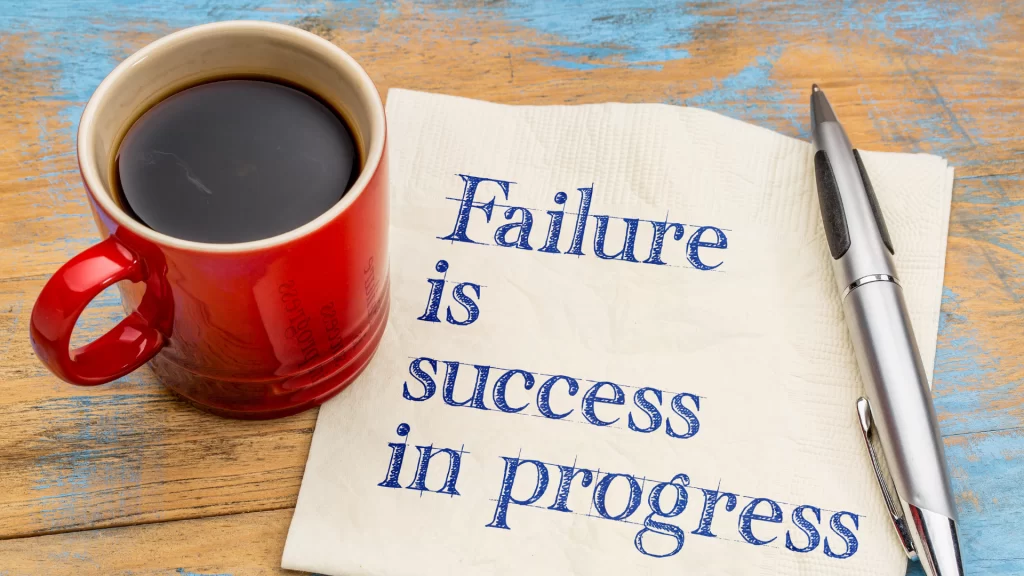
Failure, then, is not the opposite of success. It is woven into the process of achieving it.
To navigate failure is to see it as a companion on the path of growth, sometimes painful, always instructive, and ultimately transformative.
Practise Self-compassion
On a more personal level, navigating failure also requires compassion toward oneself.
Too often, we are harsher critics of our own missteps than we would ever be of others. To navigate failure with self-compassion, you need to be your own shoulder to fall back on instead of beating yourself up for it.
You don’t have to excuse mistakes, but it’s always helpful to create the emotional space to recover and grow.
It allows us to recognize that failure is not final, nor is it a reflection of our entire being. Instead, it is one chapter in a larger story still unfolding.
Remind yourself that failure is not who you are, but something you experienced. Extending kindness to yourself creates space for recovery.
Also read:
- Positive Reminders for Handling Life’s Challenges
- How to Finish What You Start
- A Positive Self-Talk Guide for Tough Days
- Keystone Habits to Help you Break Bad Habits
- 21 Tough Questions to Navigate Uncertainty in Life